18 Card Games for Seniors (Easy Rules + Free Printable Rule Cards)
October 19, 2026 · 10 min read
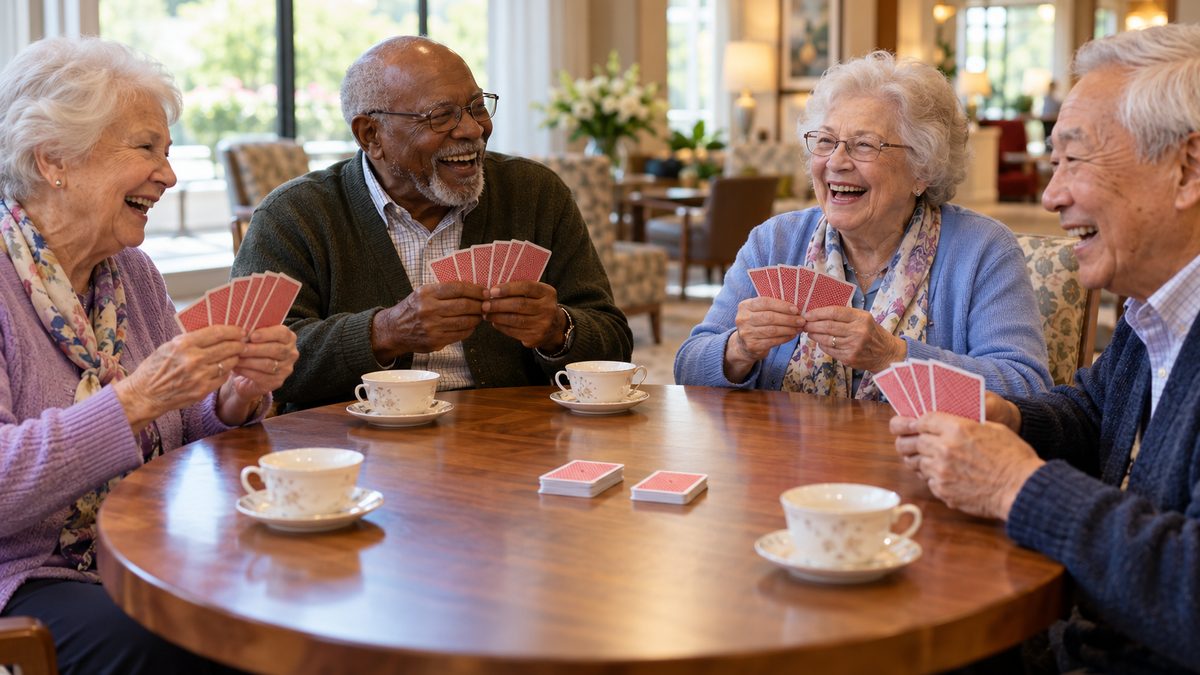
A deck of cards might be the best value in any activity room. It costs a few dollars, fits in a pocket, and many residents already know a few games by heart. Cards get people talking, give hands something to do, and turn a quiet afternoon into a regular club.
Here are 18 card games for seniors, grouped by type, from easy games to team games, with quick rules for each. Rules follow the how-to-play guides from Bicycle Cards. You can also download free printable quick-rule cards (PDF) to leave on each game table. For board, trivia and party games, see our full list of games for seniors.
Key takeaways
- A study that followed 1,091 people born in 1936 found that playing games like cards, chess, bingo and crosswords more often was linked to less cognitive decline from age 70 to 79, though it couldn’t prove cause and effect.
- Easy games like War, Go Fish, Snap and Crazy Eights suit mixed groups and beginners; War and Go Fish, played without keeping score, also work for many residents with dementia.
- Large-print cards, card holders and good lighting make cards playable for residents with low vision or arthritis.
- Play for points or chips, never money.
Why card games are good for seniors
Researchers at the University of Edinburgh followed 1,091 people born in 1936. Those who played games like cards, chess, bingo or crosswords more often showed less cognitive decline from age 70 to 79. The authors note that this was an observational study, so it can’t prove the games caused the difference (Altschul & Deary, Journals of Gerontology: Series B).
The social side matters too. A regular card table gives residents a reason to show up, a familiar skill to share and an easy way to meet new neighbors.
Easy card games (great for beginners and mixed groups)
- War. Two players split the deck and flip a card at the same time; the higher card wins both. A tie means “war”: each player lays one card face down and one face up, and the higher card takes the pile. No strategy, lots of suspense. Full rules
- Go Fish. Deal 7 cards each for two or three players, or 5 each for four or five. Ask another player for a rank you hold; if they don’t have it, you “go fish” from the pool. The most sets of four wins. Great when grandchildren visit. Full rules
- Old Maid. Remove one queen, deal all the cards, and discard pairs. Players draw from each other’s hands, and whoever ends up holding the last queen loses. Full rules
- Concentration. Spread the cards face down and turn up two at a time looking for pairs of the same rank. Use half a deck for a shorter, easier game. It’s also a classic memory game. Full rules
- Snap. Players take turns turning cards face up onto their own piles. When a player’s new card matches the top card on another player’s pile, the first to call “Snap!” wins both piles. Fast and noisy, in a good way. Full rules
- Crazy Eights. Deal 5 cards each. Match the top card of the pile by suit or rank; eights are wild, and whoever plays one names the next suit. First to play all their cards wins. Full rules
Classic social card games
- Rummy. Deal 10 cards each for two players, 7 for three or four, and 6 for five or six. Each turn, draw, lay down sets (three or four of a kind) or runs (three or more in a row in the same suit), and discard. First to get rid of all their cards wins. Full rules
- Gin Rummy. The two-player version: 10 cards each, and you can “knock” when your unmatched cards total 10 points or less. Match every card and you have “gin.” Full rules
- Kings Corner. Two to four players get 7 cards each, with four cards face up in a cross. Build down in alternating colors, and kings go in the corners. A relaxed game that is easy to pick up. Full rules
- Spoons. Place one fewer spoon than players in the middle. Pass cards around quickly; when someone collects four of a kind and grabs a spoon, everyone grabs. No spoon earns a letter in S-P-O-O-N. Play it seated, place large serving spoons within everyone’s easy reach, and agree on a no-lunging rule. For residents with fragile skin or balance concerns, tap the table instead of grabbing. Full rules
- I Doubt It. Players lay cards face down in order (aces, then twos, and so on) and say what they are, bluffing when they have to. Anyone can call “I doubt it!” If the player was bluffing, they take the pile; if not, the doubter does. First to play all their cards wins. Full rules
- Blackjack (for fun). Try to get closer to 21 than the dealer without going over. Play for points or tokens only, never money. Full rules
Trick-taking, team and scoring games
- Hearts. Usually four players with 13 cards each and no trump. Each heart you take is 1 point and the queen of spades is 13, so the lowest score wins. Full rules
- Spades. Spades are always trump. Players bid how many tricks they’ll win and score 10 points per trick bid if they make it. Game to 500. Full rules
- Euchre. Four players in two teams use a short 24-card deck (nines through aces). The jack of the trump suit is the highest card, and the first team to 10 points wins. Full rules
- Canasta. A team game with 11 cards each in the four-player game. Jokers and twos are wild, and a canasta is seven or more cards of the same rank. First team to 5,000 points wins, so it suits a weekly ongoing match. Full rules
- Cribbage. Two or three players score with a pegboard, counting to 31 during play and scoring pairs, runs and fifteens. First to 121 wins. A long-time favorite for two players. Full rules
A card game for one
- Solitaire. Classic Klondike solitaire uses seven piles. Build down in alternating colors and move each suit up from ace to king. A calm choice for quiet time in a resident’s room. Full rules
Which card game should you choose?
| If you need… | Try |
|---|---|
| A game anyone can learn in a minute | War, Go Fish, Snap, Crazy Eights |
| A table of experienced players | Rummy, Gin Rummy, Hearts, Cribbage |
| A team game for a weekly club | Spades, Euchre, Canasta |
| Laughter and energy | Spoons, I Doubt It, Snap |
| Something to play alone | Solitaire |
| Residents living with dementia | War, Go Fish, simple matching, sorting cards by suit or color |
How to adapt card games for seniors
- Use large-print cards. Jumbo-index decks with big numbers are much easier to read.
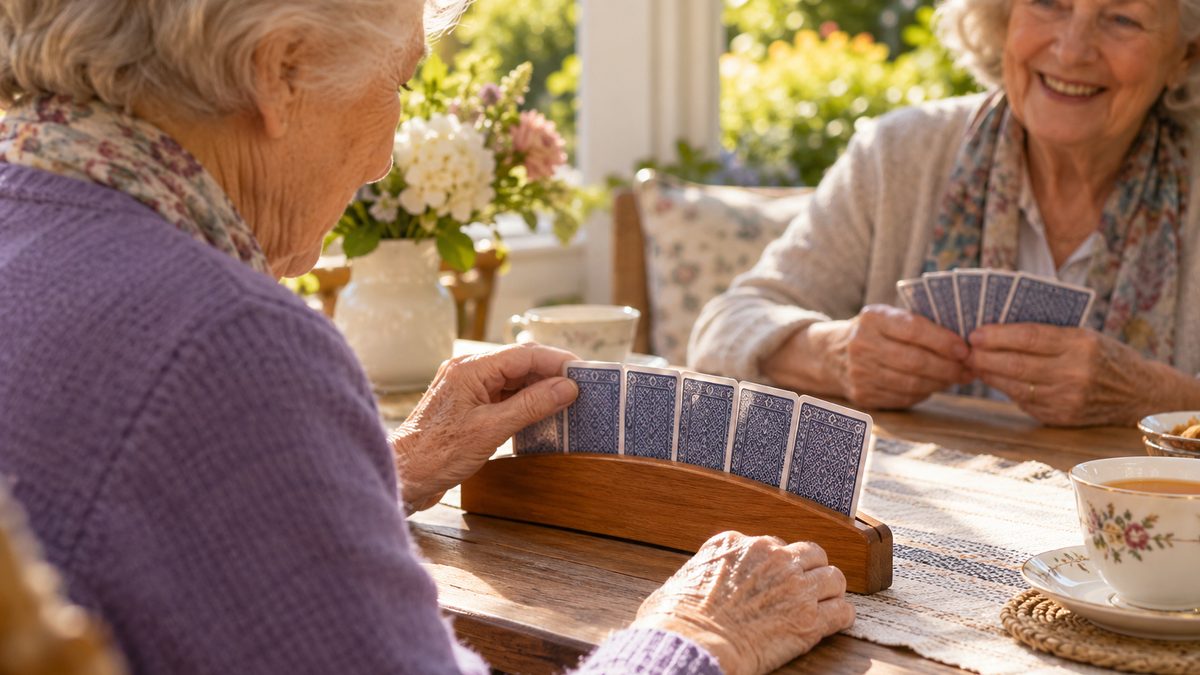
- Offer card holders. A wooden or plastic holder helps residents with arthritis or a weak grip hold a full hand.
- Light the table well. Bright, even light and a plain, dark tablecloth make cards stand out.
- Shorten games. Play to a lower score or set a time limit so games don’t run past the session.
- Leave the rules out. A printed quick-rule card on each table settles rule questions and helps new players join.
- Pair new players with veterans. Let an experienced resident teach. It builds confidence on both sides.
Card games for seniors with dementia
The National Institute on Aging suggests matching activities to what the person can still do, helping them get started and watching for frustration (National Institute on Aging). With cards, that might mean:
- Playing a simple game like War or Go Fish one-on-one, without keeping score.
- Sorting cards by color or suit, or putting a suit in order from ace to king.
- Matching pairs with a few cards face up rather than face down.
- Simply shuffling and dealing, which can feel familiar and calming.
For more ideas, see our games for dementia patients and free printable activities for dementia patients.
How to start a weekly card club
- Pick a set time. The same afternoon each week builds a habit.
- Set up two or three tables. One easy game, one classic and one team game.
- Find a table captain. A volunteer or confident resident keeps play moving.
- Keep a friendly leaderboard. A monthly “card champion” title adds fun without pressure.
- Mix it up. Alternate with board games for seniors, bingo and trivia for variety.
Plan your game afternoons in minutes
ActivityBuilder lets you add a weekly card club to your activity calendar alongside 580+ ready-to-run activities, plus built-in games like a bingo caller and trivia you can run on your activity room TV. Start a free trial and keep the card tables full.
Frequently Asked Questions
What are the best card games for seniors?+
Popular choices include Rummy, Gin Rummy, Kings Corner, Hearts, Spades, Euchre, Canasta, Cribbage and Solitaire for experienced players, and War, Go Fish, Snap and Crazy Eights for easy, quick games.
What are easy card games for elderly people?+
War, Go Fish, Old Maid, Snap, Concentration and Crazy Eights all have simple rules that can be learned in a minute or two.
What card games are good for seniors with dementia?+
Simple games like War or Go Fish played without score, matching pairs with cards face up, and sorting cards by color or suit often work well. Focus on enjoyment rather than winning.
Are card games good for the brain in older adults?+
A study following 1,091 people born in 1936 found that playing games like cards, chess, bingo and crosswords more often was linked to less cognitive decline from age 70 to 79. It was an observational study, so it can’t prove the games caused the difference.
How can seniors with arthritis or low vision play cards?+
Use large-print or jumbo-index cards, a card holder to keep the hand upright, bright even lighting and a plain dark tablecloth. Shorter games also help reduce fatigue.
Stop planning from scratch
ActivityBuilder gives you 580+ ready-to-use activities, 30+ in-browser games, and a drag-and-drop calendar builder — everything in this article, done for you.
Start your 7-day free trial →