11 Free Printable Activities for Dementia Patients (Large-Print PDFs)
October 19, 2026 · 7 min read

A good printable can be a quiet win: something familiar to hold, a task that can be finished, and a reason to sit and talk. The trouble is that many free worksheets online are made for children, with tiny print and cartoon art that can feel insulting to an adult.
Below are 11 free printable activities made for adults living with dementia. Each one is a large-print PDF with high contrast and plenty of white space. Download them, print at 100% on US Letter paper, and use them one-on-one or with a small group. For activities that don’t need paper, see our full list of dementia activities for seniors.
Key takeaways
- All 11 printables below are free PDFs with large type, simple layouts and adult-friendly designs. The word searches, Finish the Phrase and What Doesn’t Belong? include answer keys.
- The Alzheimer’s Association advises caregivers to focus on enjoyment, not achievement. There’s no wrong way to do these sheets.
- As a starting point, try word searches and Finish the Phrase while reading is still easy, and coloring and conversation cards when it isn’t.
- Sit beside the person, start the activity with them, and stop if they seem frustrated.
Why printable activities help people with dementia
The Alzheimer’s Association notes that people living with dementia don’t have to give up activities they love, that many activities can be adapted to the person’s ability, and that activities can reduce behaviors like wandering or agitation (Alzheimer’s Association). A printable sheet is one of the easiest ways to do that, because it’s ready the moment someone needs something to do.
The National Institute on Aging suggests matching the activity to what the person can do, helping them get started, watching for frustration and making sure they feel successful (National Institute on Aging). Every printable below was designed with those tips in mind.
The 11 free printables
Word and memory sheets
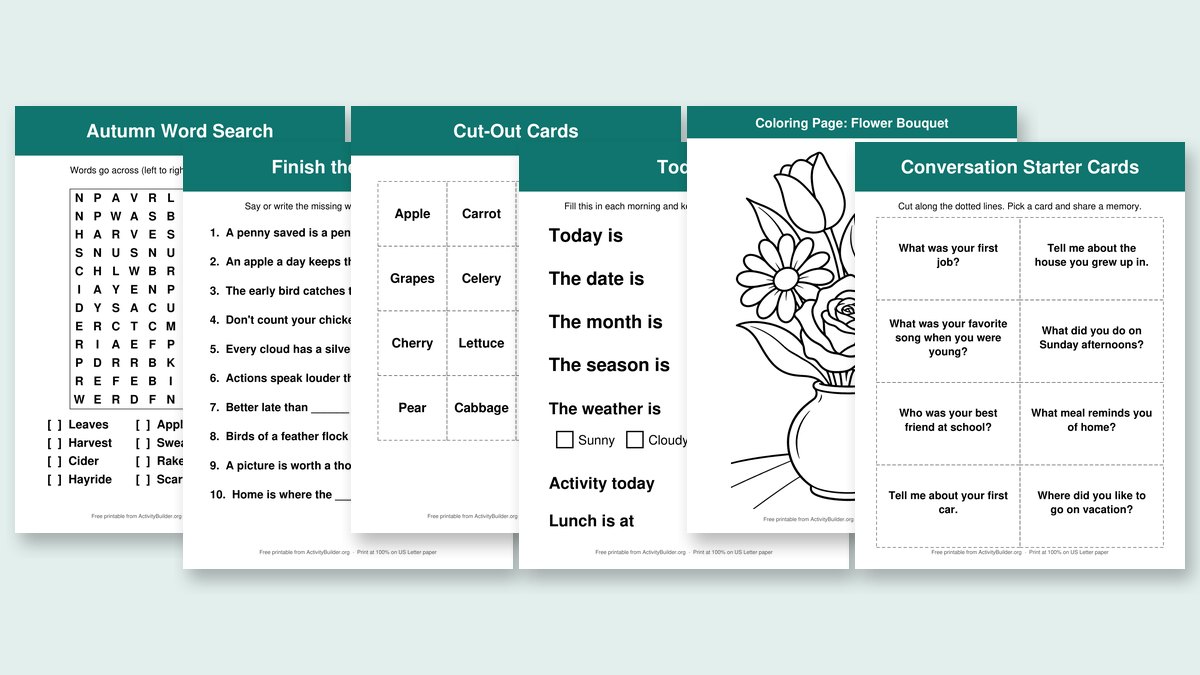
- Autumn word search (large print). 12 seasonal words like apple, pumpkin and sweater in a 12 by 12 grid. Words only run across or down, which makes them easier to spot. Includes an answer key. Download the autumn word search (PDF)
- Kitchen word search (easy). 8 everyday words like spoon, cup and bread in a smaller 10 by 10 grid with extra-large letters. A good first puzzle. Includes an answer key. Download the kitchen word search (PDF)
- Finish the Phrase. 20 well-known sayings such as “Better late than ___.” Familiar sayings can be answered out loud, so this one also works with a group. Includes an answer key. Download Finish the Phrase (PDF)
- What Doesn’t Belong? 12 rows of four words, like apple, banana, hammer, pear. Circle the odd one out and talk about why. Includes answers. Download What Doesn’t Belong? (PDF)
- Match the Opposites. Draw a line from each word to its opposite: hot and cold, day and night, open and closed. Eight pairs on one page. Download Match the Opposites (PDF)
For more word puzzles you can say out loud, see our word games for seniors and memory games for seniors.
Hands-on and sorting sheets
- Fruit or Vegetable? sorting cards. Cut out 16 large word cards and sort them into two labeled baskets. Sorting gives the hands a purposeful task with no time pressure. Download the sorting cards (PDF)
- Large-print mazes. Two mazes with wide paths, one easy and one a little harder. Trace with a finger or a thick marker. Download the mazes (PDF)
- Flower bouquet coloring page. Bold outlines and large spaces: two tulips, two daisies and a rose in a vase. Use chunky colored pencils or washable markers. Download the flower coloring page (PDF)
- Country barn coloring page. A simple farm scene with a barn, fence, tree, hills, sun and clouds that can open a conversation about where someone grew up. Download the barn coloring page (PDF)
Coloring is also a good choice for quiet afternoons. See our calming activities for dementia patients for more ideas.
Conversation and daily-routine sheets
- Conversation starter cards. 24 cut-out cards with questions like “What was your first job?” and “What meal reminds you of home?” Use them one-on-one or pass them around a small group. Download the conversation cards (PDF)
- Daily orientation board. A large “Today” sheet to fill in each morning: the day, date, month, season, weather, today’s activity and lunch time. Slip it into a sheet protector and reuse it with a dry-erase marker. Download the orientation board (PDF)
The conversation cards pair well with the ideas in our guide to reminiscence therapy activities.
Which printable fits which stage?
Everyone is different, so treat this as a starting point and watch how the person responds.
| Stage | Try first | How to help |
|---|---|---|
| Early | Autumn word search, Finish the Phrase, What Doesn’t Belong? | Offer the sheet and let them work on their own. Check in now and then. |
| Middle | Kitchen word search, Match the Opposites, sorting cards, easy maze | Sit beside them, read the words aloud, and do the first one together. |
| Later | Coloring pages, conversation cards | Focus on the moment. Read the cards aloud for them, color side by side, or simply chat. |
How to use printables well
- Print large and clear. Print at 100% (not “fit to page”) on bright white paper. A black pen or thick marker is easier to see than pencil.
- Offer one sheet at a time. A stack of pages can feel like homework. Put one sheet down and keep the rest out of sight.
- Help them get started. Read the first word, point to the first card, or do the first item together, as the NIA suggests.
- Keep it adult. Call it a puzzle or a project, never a worksheet, and skip anything that looks like it was made for children.
- Stop before frustration. If the person becomes upset, put the sheet away and try something else, like music or a short walk. Watching someone else do it is fine too.
- Prepare cut-outs safely. Staff or family should cut out the sorting and conversation cards ahead of time and stay nearby while they’re in use. If someone tends to put objects in their mouth, skip the cut-out cards and use a coloring page instead. Choose washable, non-toxic markers.
In nursing homes, federal rules require an ongoing activities program based on each resident’s assessment, care plan and preferences, covering group, individual and independent activities (42 CFR 483.24(c)). A folder of printables is a simple way to support independent and one-on-one time, especially for residents who don’t join group programs.
More free activity ideas
Printables are one tool among many. Mix them with movement, music and games from our lists of games for dementia patients and brain exercises for seniors, and add seasonal ideas from fall activities for seniors and our day-by-day November activities for seniors.
Plan memory care activities in minutes
ActivityBuilder gives activity directors 580+ ready-to-run activities, an activity calendar builder and built-in games you can run on the activity room TV. Start a free trial and spend less time searching for printables and more time with residents.
Frequently Asked Questions
Where can I find free printable activities for dementia patients?+
This page offers 11 free large-print PDFs made for adults with dementia: two word searches, Finish the Phrase, What Doesn’t Belong?, Match the Opposites, fruit or vegetable sorting cards, mazes, two coloring pages, conversation starter cards and a daily orientation board.
What makes a printable activity dementia-friendly?+
Large, high-contrast print, plenty of white space, one task per page, and adult designs rather than children’s cartoons. Familiar content, like common sayings or everyday objects, also helps.
What printable activities are best for later-stage dementia?+
Coloring pages with bold outlines and conversation cards read aloud by a caregiver are good places to start. Focus on enjoyment and connection rather than finishing the page.
Are worksheets good for people with dementia?+
They can be, if they match the person’s abilities and feel like a puzzle or project rather than a test. The Alzheimer’s Association advises focusing on enjoyment, not achievement, and the National Institute on Aging suggests watching for signs of frustration.
How should I print dementia activity sheets?+
Print at 100% scale on US Letter paper, on bright white paper, and give the person a thick marker or black pen. A sheet protector and dry-erase marker let you reuse pages like the daily orientation board.
Stop planning from scratch
ActivityBuilder gives you 580+ ready-to-use activities, 30+ in-browser games, and a drag-and-drop calendar builder — everything in this article, done for you.
Start your 7-day free trial →