Board Games for Seniors: 30 Best Picks (Classic, Easy and Dementia-Friendly)
October 8, 2026 · 9 min read

A good board game does a lot at once: conversation, friendly competition, a little brain work and a reason to sit down together. Many residents grew up with checkers, Scrabble and dominoes, and newer games can bring fresh energy to a weekly game club.
Here are 30 of the best board games for seniors, grouped by type, plus how to adapt them for low vision, arthritis and dementia, and how to run a game club residents keep coming back to. For card, trivia and party games, see our full list of games for seniors.
Key takeaways
- A study that followed 1,091 people born in 1936 found that playing games like cards, chess, bingo and crosswords more often was linked to less cognitive decline from age 70 to 79, though it couldn’t prove cause and effect.
- Pick games by group size, rules complexity and how long a round takes. Short, simple games usually work best.
- Large pieces, high contrast and easy-grip components make games playable for residents with low vision or arthritis.
- For residents with dementia, use simple, familiar games and avoid small pieces that could be swallowed.
Why board games are good for seniors
Researchers at the University of Edinburgh followed 1,091 people born in 1936, tested at ages 11, 70, 73, 76 and 79. Those who played games like cards, chess, bingo or crosswords more often had better thinking skills at 70 and less cognitive decline from 70 to 79, especially in memory. The authors are clear that this was an observational study, so they can’t say the games caused the difference (Altschul & Deary, Journals of Gerontology: Series B).
For activity directors, the everyday benefits matter just as much: games give residents a natural way to meet people, laugh, and feel competent at something they’ve done all their lives.
Classic strategy games
- Checkers. Familiar rules, quick games, and easy to teach a newcomer. Great for a ladder tournament.
- Chess. A favorite for residents who played for years. Pair players of similar skill, or play one move a day on a lounge board.
- Backgammon. Dice plus strategy, for two players. Games are quick, so it’s easy to play a best-of-three.
- Chinese checkers. Up to six players race marbles across a star-shaped board. Not for memory care, since the marbles are small.
- Othello. Flip discs to your color. Learn it in a minute, and every game is different.
- Mancala. An ancient counting game of moving stones around a board. Calm and satisfying, but the stones are small, so it’s not for memory care.
Word and tile games
- Scrabble. The classic word game. Look for large-print versions, and relax the rules for friendly play.
- Upwords. Like Scrabble, but you can stack letter tiles on top of existing words.
- Rummikub. Number tiles in runs and groups, much like rummy. A long-time senior living favorite.
- Qwirkle. Match tiles by color or shape. Simple, colorful and great for mixed abilities.
- Bananagrams. Race to build your own crossword grid from letter tiles. Play it slowly for a calmer table.
- Boggle. Find words in a grid of letter cubes. Try a group version where everyone calls out words together. More in our word games for seniors list.

Easy luck and race games
- Parcheesi. Roll the dice and race your pawns home. Many residents remember it from childhood.
- Sorry! Draw a card, move your pawn, and send opponents back to start. Plenty of laughs.
- Trouble. The pop-up dice dome is easier than throwing dice for hands with arthritis.
- Chutes and Ladders. Pure luck and no reading, which makes it a good choice when grandchildren visit.
- Monopoly. A classic many residents know. Set a time limit or play a shortened version so games don’t drag.
- Mexican Train dominoes. A social dominoes game for a big table. Jumbo, high-contrast tiles help with vision.
Social and party board games
- Trivial Pursuit. Play in teams, and pick easier question cards or decades residents know well.
- Pictionary. Draw clues on a big whiteboard so the whole room can play.
- Scattergories. Name things in categories that start with the same letter. Works well as a team game.
- Sequence. Play cards to claim spaces on the board and make five in a row. Great in teams of two.
- Codenames. A team word-association game that gets a whole table talking.
- Clue. Solve the mystery by asking questions and ruling out suspects. Play in pairs to share the detective work.
Modern family and cooperative games
- Ticket to Ride. Collect train cards and claim routes across a map. A good first “modern” game for strategy lovers.
- Blokus. Place colorful shapes on a grid. Easy to learn and very visual, but the pieces are thin and some are tiny, so it suits residents with good fine-motor control, not memory care.
- Carcassonne. Lay tiles to build a countryside of roads and cities. Relaxed and different every time.
- Azul. Pick colorful tiles to complete a pattern. Beautiful pieces and short rounds.
- Forbidden Island. A cooperative game where players work together to win, so nobody loses alone.
- Connect Four. Drop discs to get four in a row. Standard discs are coin-sized, so for memory care use a giant or jumbo version with big discs.
How to adapt board games for seniors
For low vision: choose large-print or jumbo editions, high-contrast boards and pieces, and good lighting without glare. A magnifier helps with small cards.
For arthritis or tremors: use chunky pieces, card holders, dice trays or pop-up dice, and boards with raised edges so pieces don’t slide.
For hearing loss: seat players face to face, keep background noise down, and write scores where everyone can see them.
For shorter attention spans: play shorter rounds, simplify scoring, and stop while everyone is still having fun.
Board games for seniors with dementia
- Choose familiar games from residents’ past, like jumbo checkers or jumbo dominoes, and keep the rules flexible.
- Focus on taking part, not winning. Cooperative play and team play remove pressure.
- Avoid small pieces such as marbles, stones and small tiles that could be swallowed, and supervise closely.
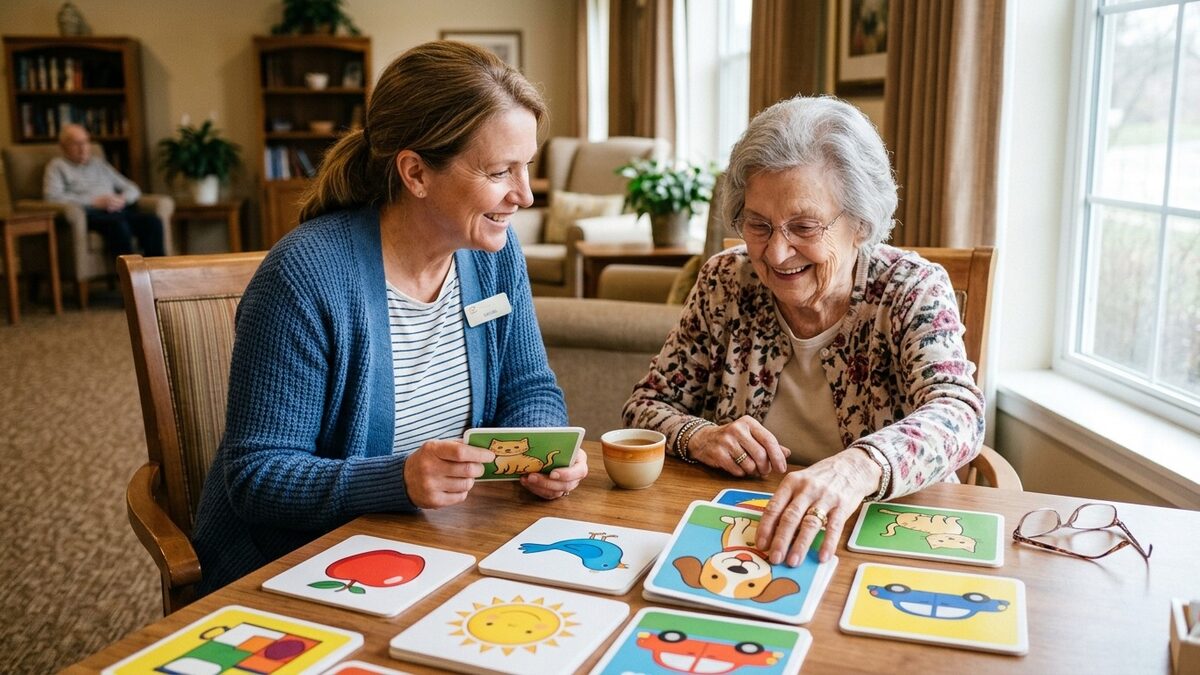
- Large picture-matching games, giant Connect Four and jumbo dominoes often work well.
- See our full list of games for dementia patients for stage-by-stage ideas.
How to run a weekly board game club
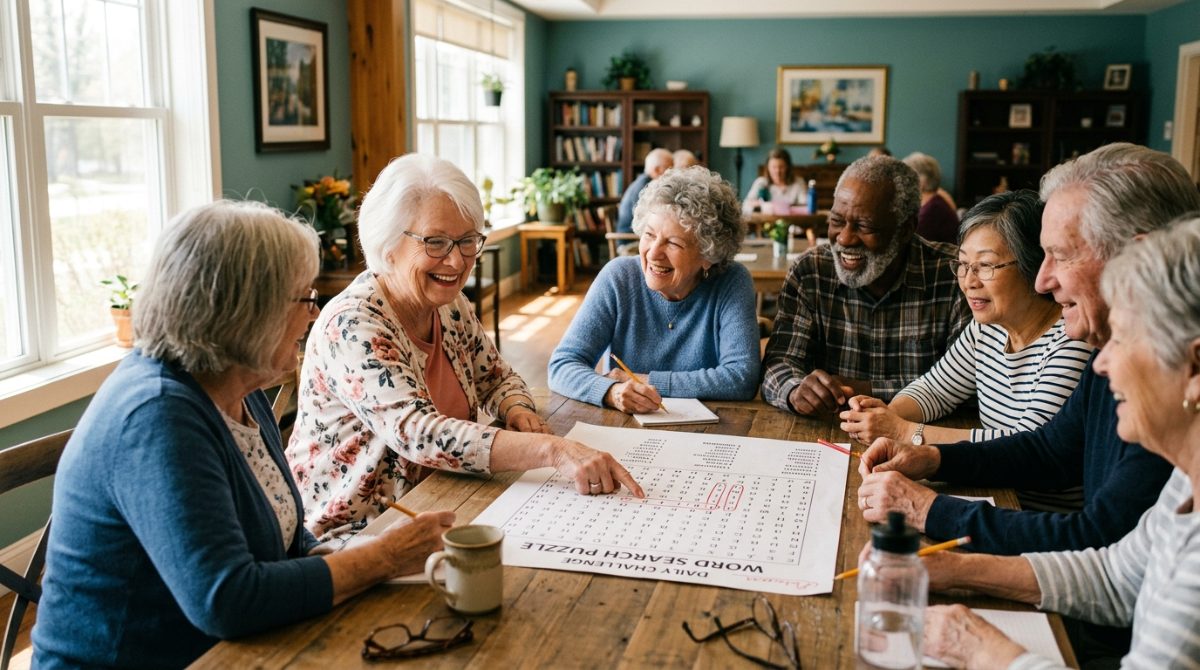
- Set a regular time. The same day and time each week helps residents remember and plan.
- Offer two or three tables. One quick classic, one word game, one “game of the month” to teach.
- Recruit table hosts. A volunteer or a confident resident can teach rules and keep play moving.
- Keep score lightly. A monthly leaderboard or a “champion of the month” adds fun without pressure.
- Invite families. Game nights are an easy way to bring grandchildren and residents together.
Pair your game club with bingo, trivia and memory games for a full week of variety.
Plan your game nights in minutes
ActivityBuilder lets you schedule a weekly game club on your activity calendar alongside 580+ ready-to-run activities, and includes built-in games like a bingo caller and trivia you can run on your activity room TV. Start a free trial and keep the game tables full.
Frequently Asked Questions
What are the best board games for seniors?+
Popular choices include checkers, chess, Scrabble, Rummikub, Qwirkle, Mexican Train dominoes, Sorry!, Trouble, Clue, Sequence, Trivial Pursuit played in teams, Ticket to Ride, Blokus and Connect Four.
What board games are good for seniors with dementia?+
Simple, familiar games work best: jumbo checkers, jumbo dominoes, large picture-matching games and giant Connect Four. Focus on taking part rather than winning, and avoid small pieces such as marbles or stones that could be swallowed.
Are board games good for the brain in older adults?+
A study following 1,091 people born in 1936 found that playing games like cards, chess, bingo and crosswords more often was linked to less cognitive decline from age 70 to 79. It was an observational study, so it can’t prove the games caused the difference.
What are easy board games for seniors?+
Easy options include Chutes and Ladders, Sorry!, Trouble, Parcheesi, Connect Four, Qwirkle, Othello and checkers. They have simple rules and short rounds.
How do you adapt board games for seniors with low vision or arthritis?+
Use large-print or jumbo editions, high-contrast pieces, good lighting, card holders, dice trays or pop-up dice, and boards with raised edges. Chunky pieces are easier to grip.
Stop planning from scratch
ActivityBuilder gives you 580+ ready-to-use activities, 30+ in-browser games, and a drag-and-drop calendar builder — everything in this article, done for you.
Start your 7-day free trial →