Hobbies for Seniors: 45 Ideas to Try in Senior Living (By Interest & Ability)
September 27, 2026 · 8 min read
A good hobby gives a day shape. It's something to look forward to, something to get better at, and something to talk about with the person in the next chair. For residents in senior living, a hobby can also bring back an identity that retirement or a move took away: the gardener, the woodworker, the family historian, the one who always had a camera.
This guide gives you 45 hobbies for seniors, grouped by interest, with notes on who each one suits and how to adapt it. You'll also find unusual ideas, options for residents with limited mobility or dementia, and a simple way to turn one-off activities into standing hobby clubs. If you're looking for one-time events rather than ongoing pastimes, our activities for seniors in assisted living guide covers those.
Key takeaways
- A 2023 study of more than 93,000 adults aged 65+ across 16 countries linked having a hobby to fewer depressive symptoms and higher happiness and life satisfaction.
- Match hobbies to the person's past roles and interests first, then adapt for mobility, vision, and memory.
- Hobbies stick when they're recurring: a weekly club with a regular time, place, and host beats a one-off class.
- Almost every hobby here can be scaled down to a seated, short, or sensory version.
Why hobbies matter so much for older adults
The evidence for hobbies is solid. In a study published in Nature Medicine in September 2023, researchers led by University College London analyzed data from 93,263 people aged 65 and over in England, the United States, Japan, China, and 12 other European countries. Having a hobby was linked to fewer depressive symptoms and higher levels of happiness, self-reported health, and life satisfaction, and the pattern held across all 16 countries (Nature Medicine, 2023). Because it was an observational study it can't prove cause and effect, but having a hobby was also linked to later drops in depressive symptoms and gains in happiness and life satisfaction.
In practice, you'll see the same thing on your floor. A resident with a hobby has a reason to leave their room, a skill to share, and an easy conversation starter. That's why hobbies deserve a permanent place on the activity calendar, not just an occasional slot.
How to match a hobby to a resident
The best predictor of a hobby sticking is the person's history. Before you suggest anything, ask what they did for work, what they did on weekends, and what they always meant to try. Then use a quick matching table like this one:
| If they used to… | Try… | Easy adaptation |
|---|---|---|
| Work with their hands (trades, farming, mechanics) | Woodworking kits, model building, birdhouses | Pre-cut kits, sanding and painting only |
| Keep a home and garden | Container gardening, flower arranging, baking | Raised planters, tabletop herb pots |
| Teach, write, or keep records | Memoir writing, genealogy, book club | Dictate stories to a volunteer or voice recorder |
| Sew, knit, or quilt | Knitting circle, lap blankets for charity | Chunky yarn, loom knitting, finger knitting |
| Follow sports | Fantasy leagues, sports trivia, putting green | Seated games, team-based trivia |
| Love music | Choir, hand bells, music appreciation | Sing-alongs, rhythm instruments |
A short interest survey at move-in (and again once a year) makes this far easier. Keep the answers somewhere your whole team can see.
Creative and artistic hobbies
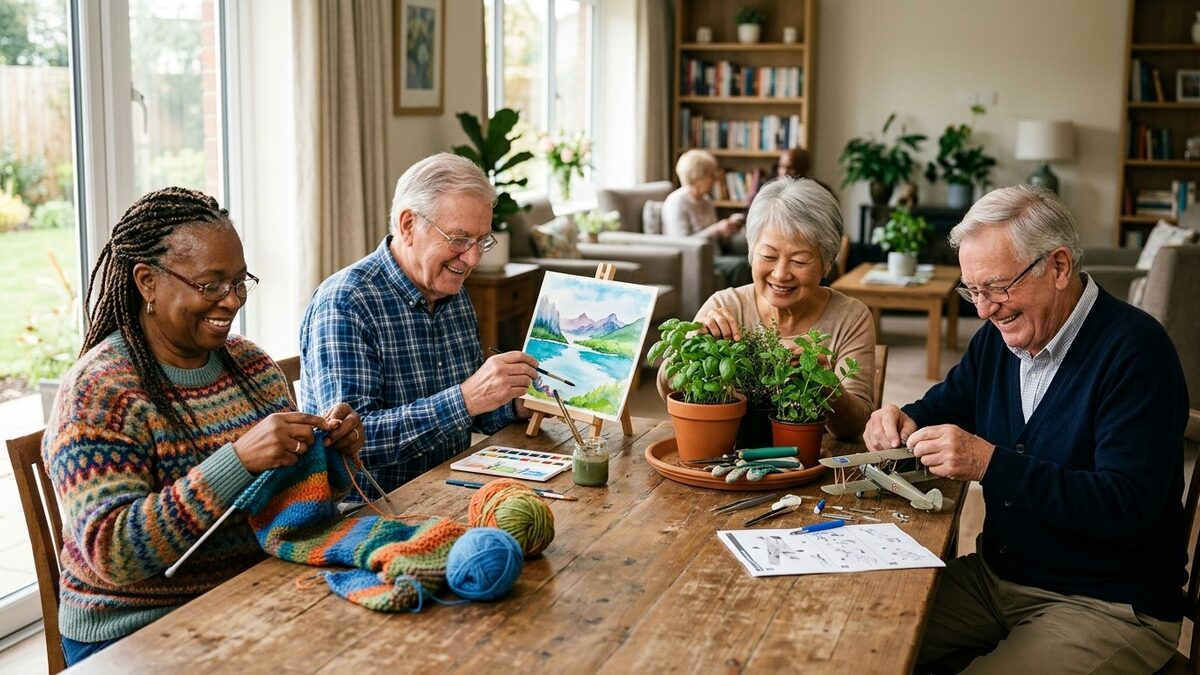
- Watercolor painting. Forgiving, portable, and beautiful even when it's loose. Start with washes and simple landscapes.
- Acrylic pour painting. No drawing skill needed, and every result looks different.
- Sketching and drawing. A pencil and a sketchbook go anywhere. Try still-life setups of seasonal objects.
- Adult coloring. Detailed designs for steady hands, bold ones for low vision.
- Pottery and clay. Air-dry clay avoids the need for a kiln. The texture is calming too.
- Photography. Phone cameras make it easy. Run a monthly photo walk and print the favorites for a hallway gallery.
- Calligraphy and hand lettering. Brush pens make it approachable, and cards make great gifts.
- Scrapbooking. It doubles as reminiscence, since it prompts residents to tell the stories behind the photos.
- Mosaic art. Glue pre-cut glass or paper tiles onto coasters, frames, or stepping stones.
For project-by-project instructions, see our craft activities for seniors guide.
Hands-on making hobbies

- Woodworking kits. Birdhouses, planters, and toy cars from pre-cut kits. Residents sand, glue, and paint, with no power tools needed.
- Model building. Airplanes, ships, and classic cars. Snap-fit kits suit shakier hands.
- Knitting and crochet. The classic group hobby. Circles often become the friendliest table in the building.
- Quilting. A shared community quilt lets everyone contribute a square.
- Jewelry and beading. Large beads and elastic cord keep it simple.
- Fixing and tinkering. A "repair table" for small household items gives former handymen a purpose.
- Leather crafts. Pre-punched kits for wallets, keychains, and bookmarks.
- Fishing-fly tying. Detailed, meditative work for former anglers. Use a magnifier lamp.
Supervise hobbies that involve sharp tools, such as fly-tying hooks, leather punches, and craft knives, and keep them in a locked supply bin between sessions.
Hobbies for senior men and senior women
Men's groups in senior living often gravitate to woodworking kits, model building, a repair table, fishing-fly tying, card clubs, and sports trivia. Women's groups often fill knitting circles, quilting bees, baking clubs, and flower arranging. Those are only tendencies, though. Plenty of men knit and plenty of women build models, so offer every hobby to everyone and let interest decide. A men's coffee-and-projects morning or a ladies' craft circle can help new residents find their people, as long as the door stays open to anyone.
Gardening and nature hobbies
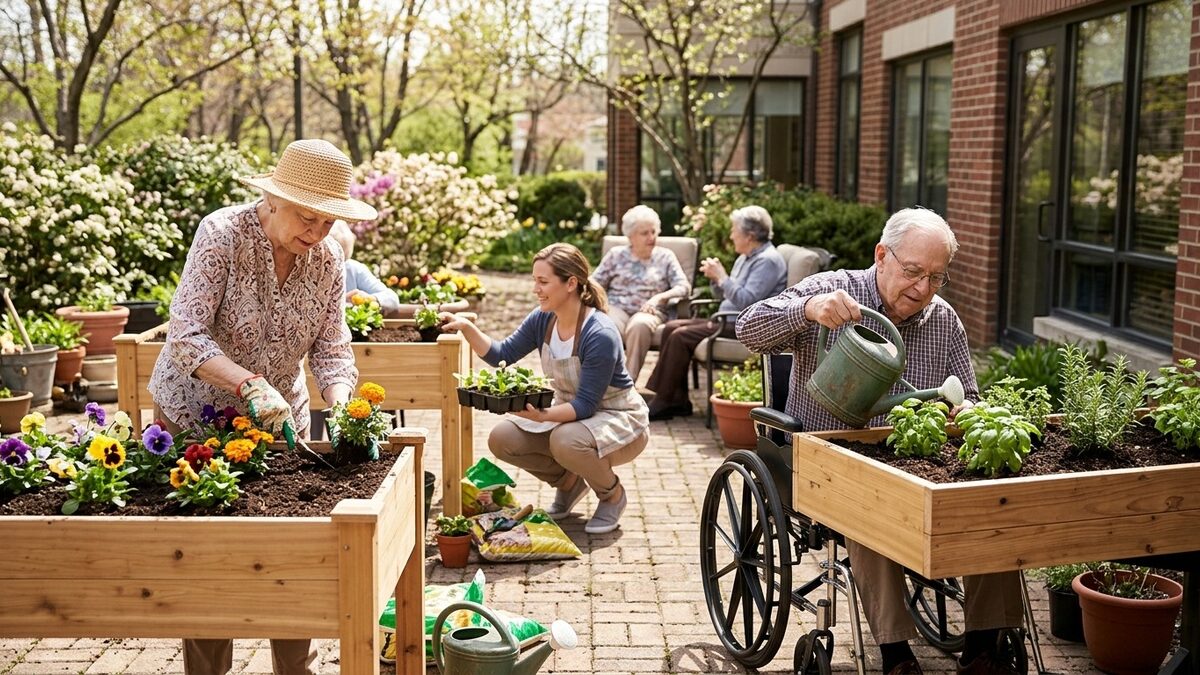
- Container and raised-bed gardening. Waist-high beds let residents garden from a chair or wheelchair.
- Indoor herb gardens. Basil, mint, and rosemary on a sunny windowsill, with a harvest for the kitchen.
- Houseplant care. A "plant parent" club adopts and tends the community's greenery.
- Bird watching. A feeder outside a lounge window, a field guide, and a shared sightings log.
- Flower arranging. Donated grocery-store flowers become table centerpieces.
- Nature journaling. Sketch or describe one thing noticed outdoors each week.
When the weather won't cooperate, our indoor activities for seniors guide has plenty of alternatives.
Mind and learning hobbies
- Puzzles. Jigsaws on a permanent table that anyone can add to.
- Crosswords and word games. See our word games for seniors for group versions.
- Chess, checkers, and bridge. Clubs with a weekly ladder or tournament keep players coming back.
- Learning a language. Free apps plus a weekly conversation table.
- Book club. Large-print and audiobook editions keep everyone included.
- Genealogy. Family-tree research is detective work, and families love the results.
- Memoir writing. A weekly prompt ("your first car," "your wedding day") builds a book over a year.
- Lifelong learning lectures. Free online courses and museum talks streamed to the TV, followed by discussion.
Our brain exercises for seniors guide covers the cognitive side in more depth.
Social and giving-back hobbies
- Choir or singing group. A great fit for mixed abilities, since voices blend.
- Card clubs. Rummy, canasta, euchre, and poker (played for chips, not money).
- Volunteering from home. Knitting hats for newborns, writing cards to troops, packing care kits.
- Pen pals. Partner with a local school for intergenerational letters.
- Cooking and baking club. Residents share family recipes and bake for events.
- Welcome committee. Longtime residents greet and orient new move-ins.
For more ideas that get whole groups involved, see group activities for seniors.
Unusual hobbies for seniors worth trying
Some residents have done the classics for decades and want something new. These less common hobbies can draw residents who want to try something new:
- Terrarium building. Tiny glass-jar worlds with moss, stones, and figurines.
- Ukulele. Four strings, a few chords, and a group can play songs within weeks.
- Tai chi. Slow, graceful movement that can be done standing or seated.
- Origami. Start big (cranes from large paper), then go smaller as skills grow.
- Stamp or coin collecting. Collections from home spark long conversations.
- Virtual travel club. Pick a country each month for a video tour, food tasting, and music.
- Podcast or oral-history recording. Residents interview each other about their lives.
- Drone or remote-control flying. A natural fit for former pilots and tinkerers (outdoors, with supervision).
Hobbies for seniors with limited mobility
Limited mobility narrows the options less than people assume. Nearly every hobby above has a seated, tabletop version. Good fits include watercolor, knitting and loom knitting, tabletop gardening, model building with snap-fit kits, photography from a window, card games, memoir writing by dictation, and music listening clubs. Use non-slip mats, larger tools, and good lighting. For more, see our guide to activities for seniors with limited mobility.
Adapting hobbies for memory care
For residents living with dementia, the aim shifts from mastering a skill to enjoying the process. Choose hobbies that rely on long-held abilities and the senses: folding laundry, sorting buttons or yarn by color, watering plants, sanding wood, kneading dough, or singing familiar songs. Keep steps to one or two at a time, set up the task so it can't fail, and praise participation rather than the result. Our dementia activities for seniors guide has a full framework.
How to turn hobbies into resident clubs
One-off classes are fun, but hobbies grow roots when they become clubs. A simple structure that works in most communities:
- Survey interests. Ask residents and families which hobbies they'd join. Launch the top three.
- Give each club a fixed slot. Same day, same time, same room every week.
- Find a resident host. A resident with experience co-leads alongside staff and gains a sense of purpose.
- Budget supplies up front. A small starter kit per club, refilled monthly.
- Show off the work. Hallway galleries, craft fairs, and family nights keep motivation high.
- Review every quarter. Drop what isn't drawing a crowd and try something new.
Keep every hobby club on the calendar
Recurring clubs are easy to plan in ActivityBuilder. Drop your weekly knitting circle, garden club, and book club onto the drag-and-drop activity calendar once and they repeat automatically. Then fill open slots with TV-ready games for seniors like bingo, trivia, and crosswords. Start a free trial and build next month's calendar in one sitting.
Frequently Asked Questions
What are good hobbies for seniors?+
Popular hobbies for seniors include watercolor painting, knitting and crochet, container gardening, woodworking kits, puzzles, book clubs, choir, card clubs, genealogy, memoir writing, and bird watching. The best choice builds on the person’s past work and interests, adapted for their mobility and vision.
Why are hobbies important for older adults?+
A 2023 Nature Medicine study of more than 93,000 adults aged 65+ in 16 countries linked having a hobby to fewer depressive symptoms and higher happiness, self-reported health, and life satisfaction. Hobbies also give structure to the day and create natural social connection.
What hobbies are good for seniors with limited mobility?+
Seated, tabletop hobbies work best: watercolor, knitting or loom knitting, tabletop herb gardening, snap-fit model building, card games, photography from a window, memoir writing by dictation, and music listening clubs. Use larger tools, non-slip mats, and good lighting.
What are some unusual hobbies for seniors?+
Terrarium building, ukulele, tai chi, origami, stamp or coin collecting, a virtual travel club, recording oral histories, and supervised remote-control or drone flying are less common hobbies that often draw residents who want to try something new.
How do you start a hobby club in senior living?+
Survey resident interests, launch the top few hobbies, give each club a fixed weekly time and room, recruit a resident co-host, budget a starter supply kit, display the finished work, and review attendance every quarter.
Stop planning from scratch
ActivityBuilder gives you 580+ ready-to-use activities, 30+ in-browser games, and a drag-and-drop calendar builder — everything in this article, done for you.
Start your 7-day free trial →